The security model
How ARKK protects you
ARKK is built on one principle: the people who run the service should not be able to read what passes through it. Here is exactly how that works, and, just as importantly, where it stops.
Identity without a name
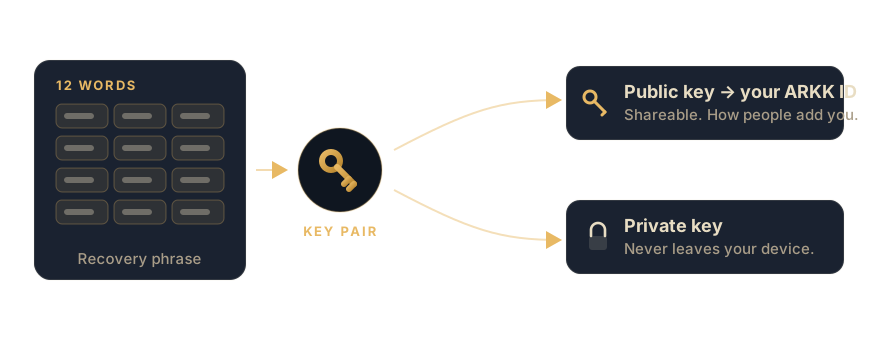
There is no sign-up and no required account. The first time you open ARKK, your device generates a 12-word recovery phrase and, from it, a pair of cryptographic keys, an Ed25519 signing key that proves it's you, and an X25519 key that seals messages to you.
The public halves register on our servers under a short fingerprint, your ARKK ID. The private halves never leave your phone's hardware-backed Keychain (iOS) or Keystore (Android). You share your fingerprint with people you want to talk to; they share theirs. That is the entire identity model, no phone number, no email, no required account. A username is optional; nothing else is tied to who you are.
Your recovery phrase is the master key. It's shown once, on a screen that blocks screenshots, and we can't recover it for you, there is no key escrow and no recovery path that could be compelled to reveal it.
End-to-end encrypted, always
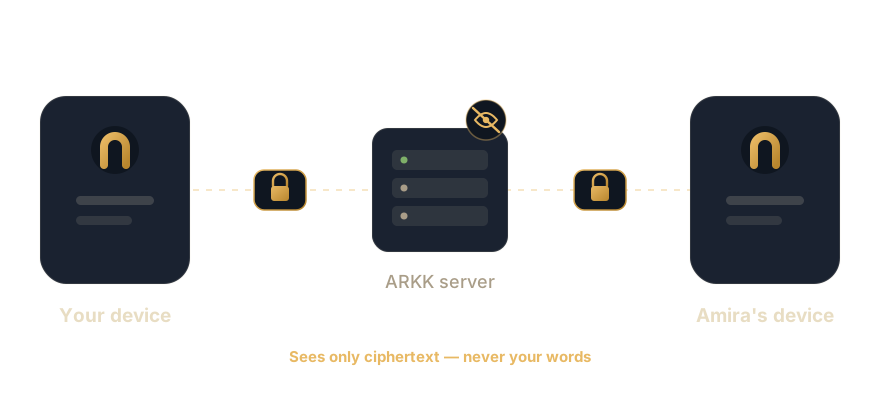
Every message, file, and voice note is sealed on your device before it leaves, using well-vetted libsodium (NaCl) public-key cryptography and the recipient's public key. Only the recipient's device holds the private key that can open it.
Our server relays ciphertext it cannot decrypt and deletes it the moment delivery is acknowledged. There is no master key, no key escrow, and no recovery system that could be compelled to read your conversations. Connections to our servers use TLS, but confidentiality never rests on the transport: every payload is end-to-end encrypted between devices, so a hostile network, or even a broken TLS connection, only ever sees ciphertext.
Server-blind by design
The encryption doesn't stop at your typed words. Control messages, a read receipt, a change to a chat's disappearing timer, a settings sync, ride inside the same encrypted envelope. To the server, a setting change is indistinguishable from a sentence: both are opaque ciphertext.
The privacy-sensitive signals ship off by default and are symmetric when you turn them on. Read receipts are off until both people opt in. Nothing about your behavior leaves your device unless you choose it.
What the server can, and can't, see
What ARKK never sees
- The content of your messages, files, or voice notes
- Your name, email, or phone number, you never gave one
- Your profile name or photo, they live only on your device
- Whether you turned on read receipts or a disappearing timer
- A stored history of who you talk to
- Your message database, it never leaves your phone
What a server necessarily handles
Honesty matters more than a tidy slogan. Any messaging server, ours included, touches some metadata to move a message at all:
- Ciphertext
- The encrypted bytes of a message, held only until delivery, at most a few days if you are offline, then erased.
- Routing fingerprint
- A recipient's public-key fingerprint, needed for the moment it takes to hand the message to the right device.
- Size and timing
- Roughly how large an encrypted payload is and when it passed through. Content stays sealed, but an observer can see that something moved.
- Network address
- The IP address your connection comes from, as any internet server sees. Use a VPN or Tor if that link matters to you.
- Username registry (only if you claim one)
- A durable username↔key mapping — the one thing we keep rather than relay, so people can find you by a handle. Skip the username and the server keeps nothing about you between messages. Releasing it, or resetting your identity, retires the handle permanently.
This is the metadata inherent to routing, not a profile we build. We don't keep a log of who talks to whom, and content is never exposed. If network-level observation is part of your threat model, pair ARKK with a VPN or Tor.
On your device
Because so little lives on the server, your phone matters. ARKK encrypts its local message database at rest, keeps identity keys in the hardware-backed keychain, and adds device-level protections you can tune:
- App lock with biometrics or your device passcode, on by default, with automatic re-lock after inactivity.
- Screenshot protection on sensitive screens, and a branded panel in the app switcher so a glance reveals nothing.
- End-to-end encryption in transit, so a network-level interception, even of a broken TLS connection, reveals only ciphertext.
- Notifications off by default, when enabled they carry only an opaque wake-up token, never sender or content.
Where protection stops
No tool is magic, and pretending otherwise would be the opposite of protection. ARKK deliberately does not defend against:
- A compromised device. If malware runs on your phone, it can read messages as you do. Encryption ends where your screen begins.
- A photograph of your screen. We block in-app screenshots; we can't stop another camera.
- Coercion. If you're forced to unlock your phone, what's on it is exposed. Keep your recovery phrase somewhere separate and safe.
- Traffic analysis. An observer watching the network can see when and roughly how much you send, even without reading it.
ARKK is a young product and has not yet had an external security audit; we'll commission one before a 1.0 release. Our cryptography rests on libsodium's well-reviewed primitives, but implementations can still carry bugs. Found one? Email security@arkk.chat.
Protection for people who need it.
Built for journalists, activists, and anyone who can't safely tie a phone number to their identity.